Dolibarr Shopify Integration: automatically sync prices, orders, and invoices
The problem: endless double entry
You sell on Shopify. Your ERP is Dolibarr. Every day, the same routine: you update a price in Dolibarr, then open the Shopify admin to manually copy the change. When an order comes in on Shopify, you re-enter it in Dolibarr. You create the invoice by hand. You go back to Shopify to mark the order as shipped and type in the tracking number.
This process eats hours every week. Data entry errors pile up: a mistyped price, a forgotten order, a swapped tracking number. At 50 products, it's annoying. At 500, it's a full-time job. And every new variant or promotion means starting all over again.
The real cost isn't just wasted time — it's risk. A wrong price on Shopify for 24 hours can generate orders at a loss. A missing invoice throws off your accounting. A forgotten tracking number triggers support tickets.
Available options
Option A: custom development. Hire a developer to build an API bridge between Dolibarr and Shopify. High upfront cost (thousands of euros), ongoing maintenance every time Shopify's GraphQL API changes, and a single point of failure if the developer moves on.
Option B: generic automation tools (Zapier, n8n, Make). These platforms don't understand Dolibarr. You'll need to build complex workflows, handle errors yourself, and accept limitations on which fields can be synced. No ERP-aware logic.
Option C: a sync tool built specifically for Dolibarr. That's exactly what ERPkit does. A free module inside Dolibarr, a cloud service that handles all the synchronization, and a web interface to configure everything — no command line needed.
Setting up ERPkit in 6 steps
Step 1: Install the free Dolibarr module
Download the ERPkit module from DoliStore (free, open source GPL v3). In Dolibarr, go to Home > Setup > Modules/Applications and activate the ERPkit module. It adds sync fields to your product cards and a configuration page for your marketplace credentials.
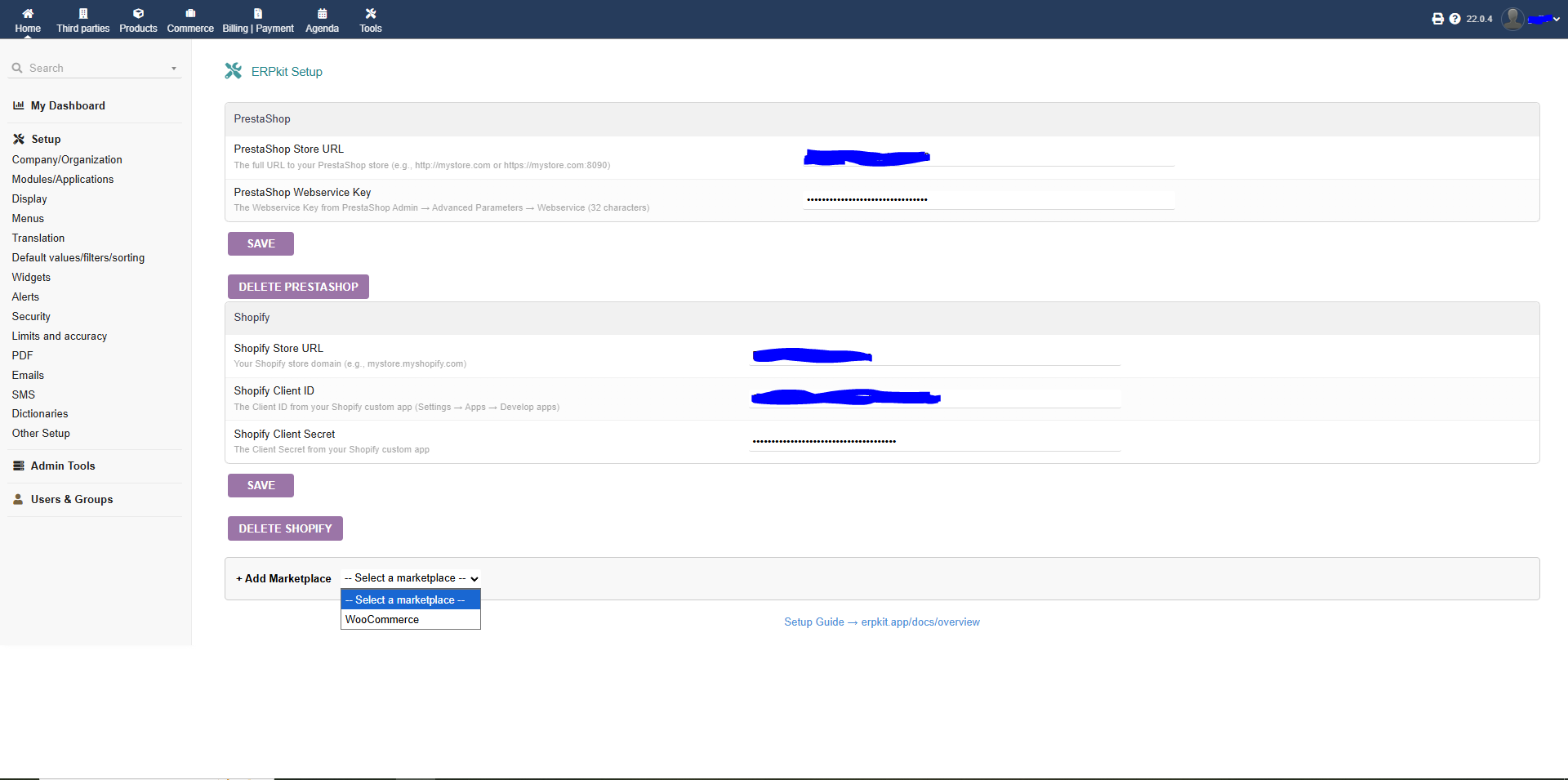
Step 2: Configure your Shopify credentials in Dolibarr
In the Dolibarr admin panel, open the ERPkit configuration page. Enter your Shopify store URL and your Shopify API token. ERPkit uses Shopify's GraphQL Admin API — a single token is all you need. Your credentials stay in your Dolibarr instance, never on our servers.
Step 3: Create an ERPkit account (free)
Head to app.erpkit.app and create your account. The free Solo tier includes 1,000 synced products, 50 imported orders, and 50 invoices per month — more than enough to get started.
Step 4: Connect your Dolibarr instance
In the ERPkit interface, add a new sync configuration. Select Shopify as the marketplace, enter your Dolibarr URL and API key. ERPkit verifies the connection and automatically detects your active modules.
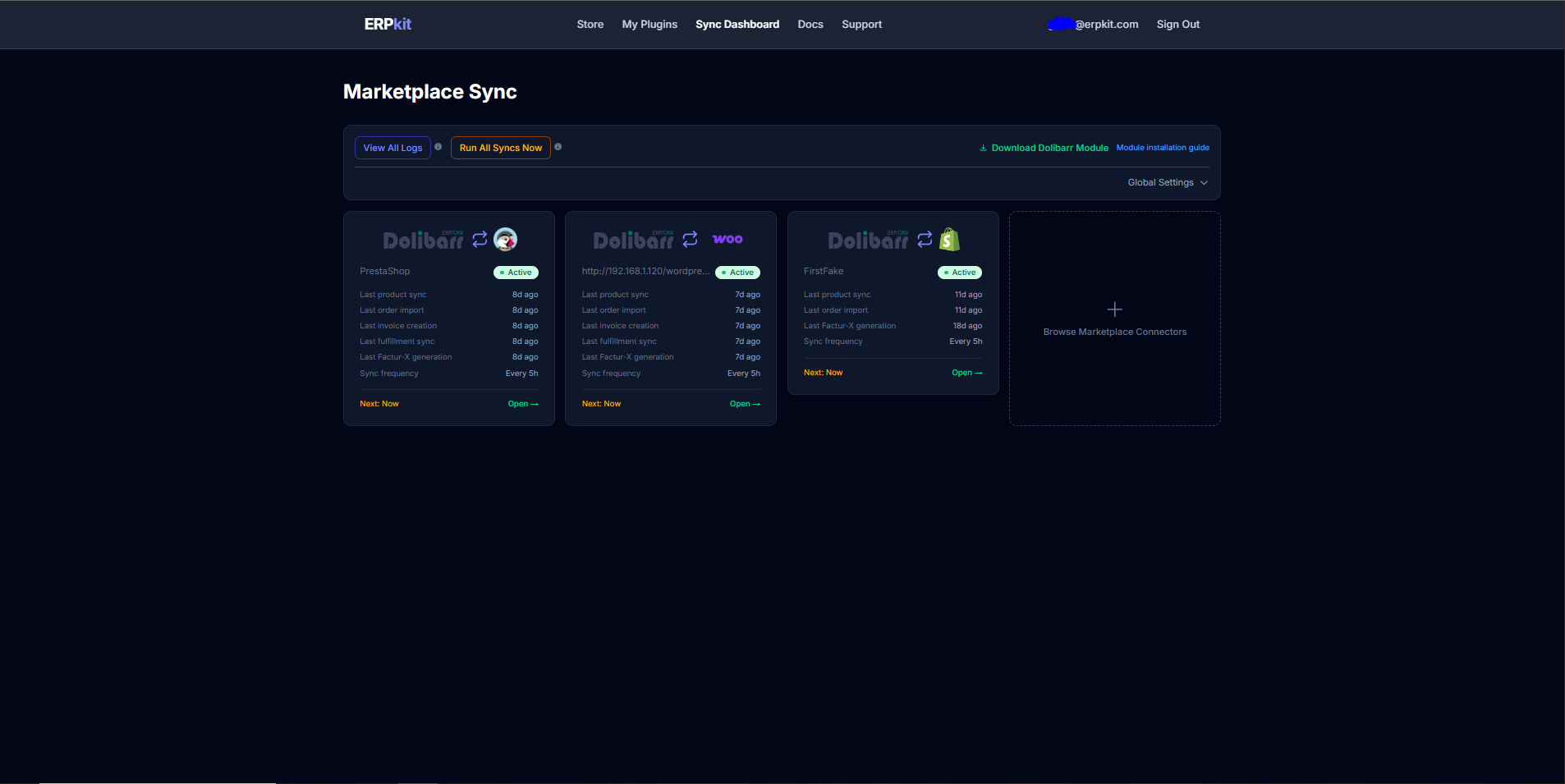
Step 5: Map your products (automatic matching)
ERPkit can automatically match your Dolibarr products to Shopify variants by comparing references (SKUs). Open the Product Mapping tab, run the auto-match, and review the proposed associations. For edge cases, you can also manually enter the Shopify variant ID in the shopify_variant_id field on the Dolibarr product card.
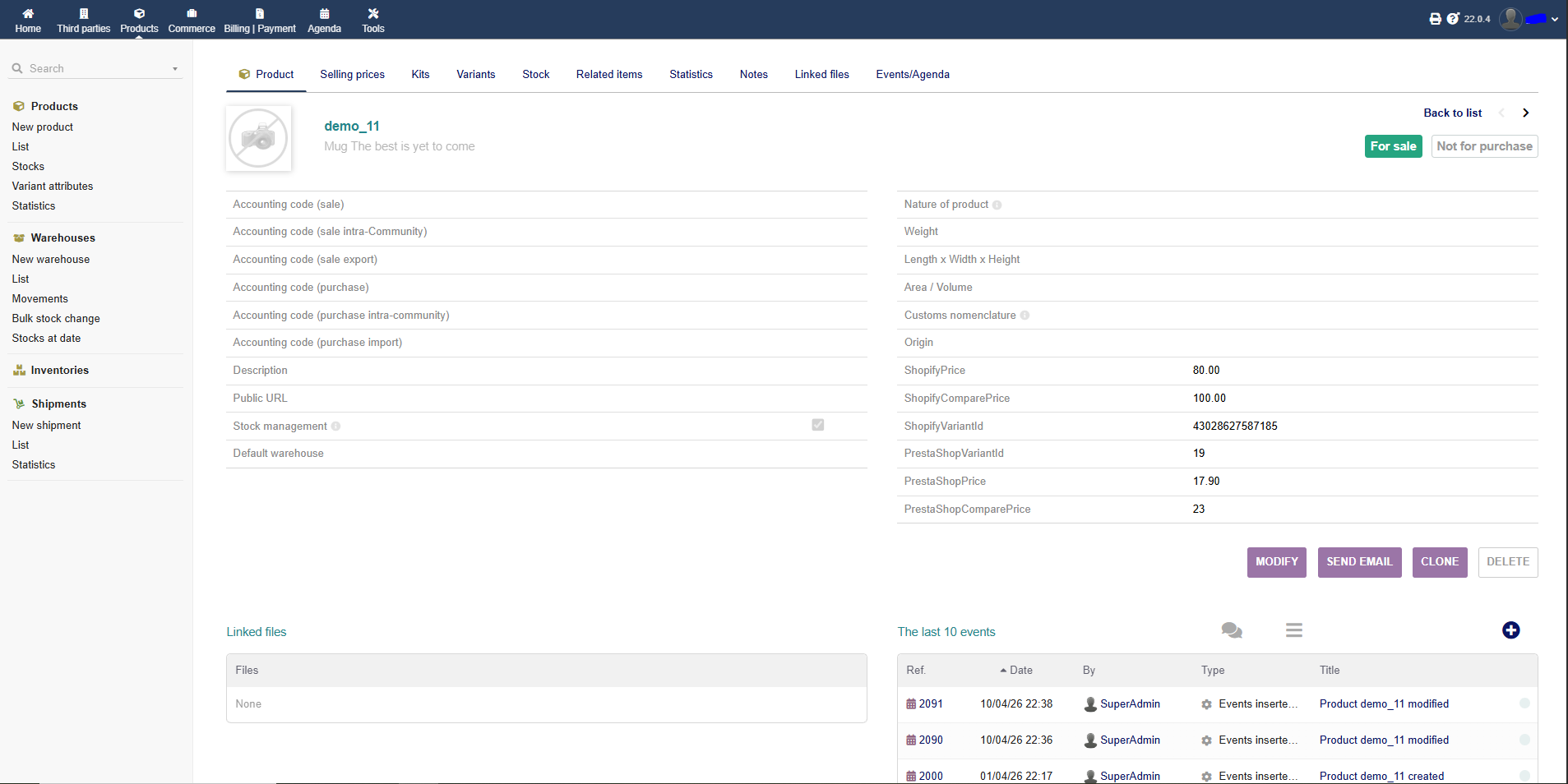
Step 6: Run your first sync
Everything is ready. From your configuration detail page, launch the sync. ERPkit pushes prices, compare-at prices, weight, and barcodes from Dolibarr to Shopify. Only changed products are sent thanks to smart delta sync — subsequent syncs are nearly instant.
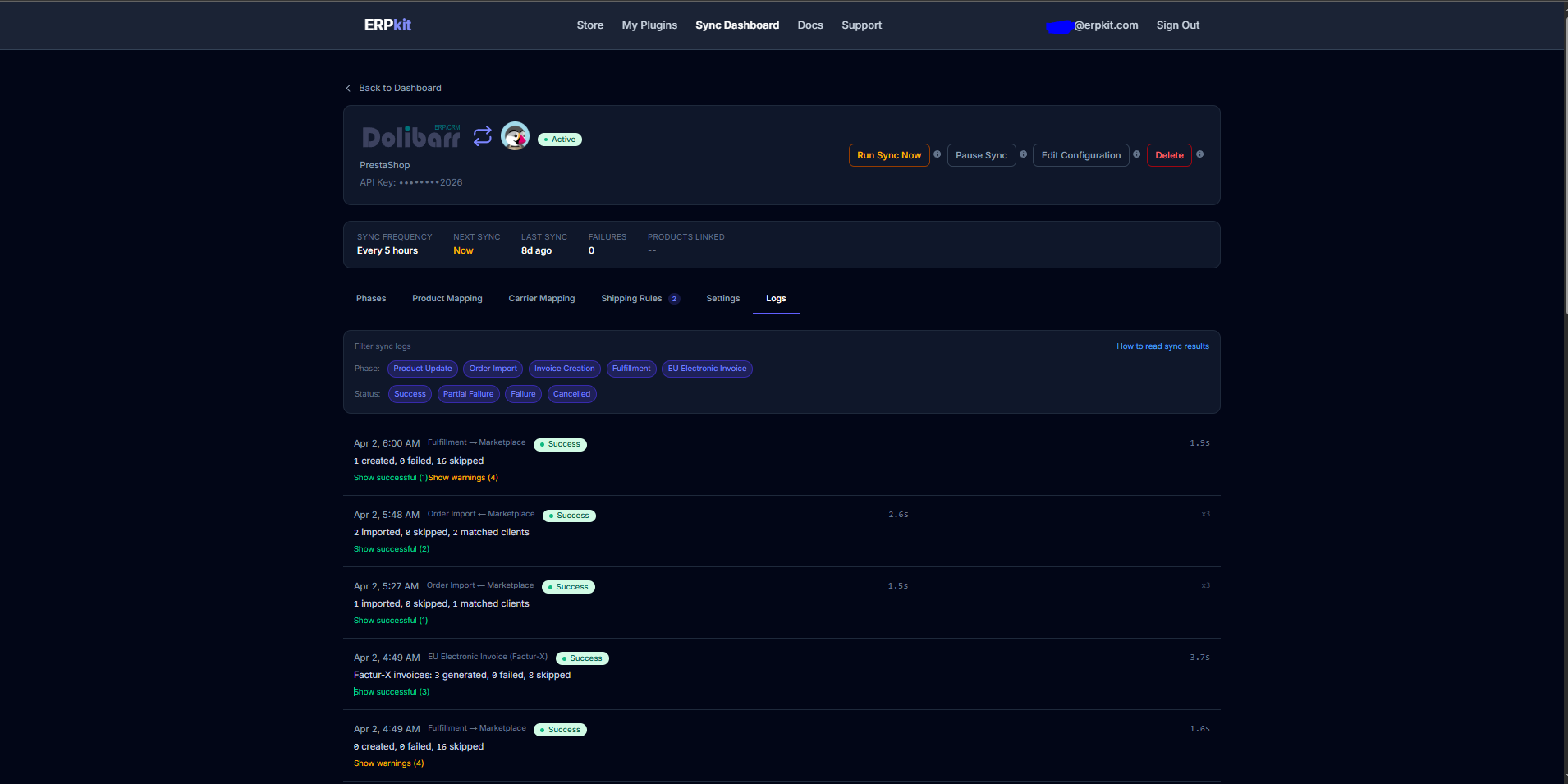
What's next?
Once product sync is in place, ERPkit also handles:
- Order import — Shopify orders arrive automatically in Dolibarr, with customer matching by email and product linking.
- Invoice generation — Invoices are created, validated, and marked as paid automatically from imported orders.
- Fulfillment — When you mark an order as shipped in Dolibarr, ERPkit pushes the status and tracking number to Shopify.
- Factur-X — Generate EU-compliant electronic invoices (PDF/A-3 with embedded CII XML) to stay ahead of e-invoicing regulations.
Important: ERPkit only sends prices, weight, and barcode data to Shopify. Your product titles, descriptions, images, and SEO data are never modified.
Get started free
No credit card required. The free Solo tier includes 1,000 products, 50 orders, and 50 invoices per month. The Dolibarr module is free and open source (GPL v3).
Get Started FreeFrequently asked questions
- Is ERPkit free?
- The Dolibarr module is completely free and open source (GPL v3). The sync service at erpkit.app offers a free Solo tier (1,000 products, 50 orders, 50 invoices per month). Paid plans start at €39/mo.
- What data is synced between Dolibarr and Shopify?
- ERPkit syncs prices, compare-at prices, weight, and barcodes from Dolibarr to Shopify. It imports Shopify orders into Dolibarr, automatically generates invoices, and pushes fulfillment status and tracking numbers back to Shopify.
- Do I need technical skills to use ERPkit?
- No. Installing the Dolibarr module takes a few clicks. Configuring credentials and linking products is done from the ERPkit web interface — no command line required.
- Does ERPkit modify my Shopify product titles or descriptions?
- No. ERPkit only sends prices, weight, and barcode data. Your Shopify product titles, descriptions, images, and SEO data are never touched.
- Is my data stored on ERPkit servers?
- No. Your marketplace credentials stay in your Dolibarr instance. The sync engine connects, transfers data, and disconnects. No data retention.